
ECEC Strategy · Industry News & Shifts
Full today isn't full next year: the waitlist myth
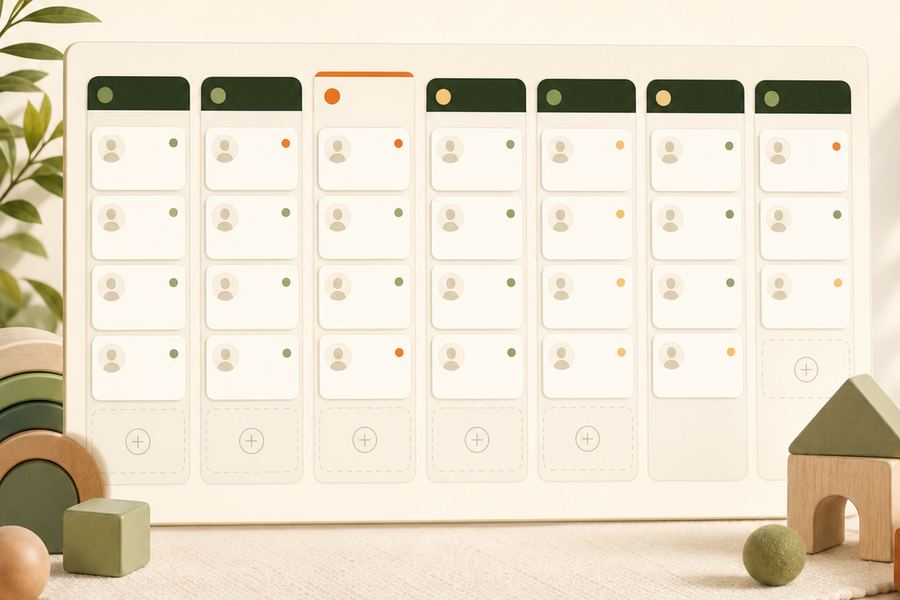
"We're full, we don't really do marketing."
I hear that sentence more than any other, and I understand why a director says it. If every room is at capacity and there's a list of families waiting, marketing can look like money spent solving a problem you don't have. The books balance. The phone rings often enough. Spending on video and content to fill places that are already full feels like the least sensible thing on the list.
It's a rational read of the situation you can see today. The trouble is that a childcare centre is never really full in a fixed way. It only looks full at a single moment, and that moment is already passing while you read this.
Why a waitlist quietly decays
Every enrolment you hold has an end date built into it. A child in the toddler room will move up, then eventually move on to kinder or school. That's not a risk, it's a certainty written into their age. Your occupancy has a clock running underneath it, and the clock never stops. A centre that feels full today is, on a longer view, a set of places steadily counting down to empty.
The waitlist is supposed to be the answer to that. But a list of names is not the same as a queue of families who will definitely enrol. A family that put their child on your list six months ago has almost certainly enquired at three or four other centres in the same fortnight. They're hedging, as any anxious parent would. By the time a place opens, some have already started elsewhere, some have moved suburb, and some can't remember filling in your form. A list nobody nurtures is a spreadsheet of strangers, and strangers don't feel loyalty to a centre they last thought about half a year ago.
Then there's the wider shift, and this is the part that catches even well-run centres off guard. The number of children in centre-based day care fell 2.8% in the year to March 2026, while licensed places grew around 4%, putting national occupancy at roughly 74.3% (Federal Education Department CCS quarterly data). Demand is thinning and supply is growing, both at once. The pool of families your waitlist is drawn from is smaller than it was, even in areas that still feel busy.
The new place down the road
Supply is the pressure most directors underestimate, because it arrives without warning. Around 30,000 new places are being built each year against roughly 11,000 places of demand growth (CBRE, March 2026). That's close to three new places for every one new child who needs care.
A new centre opening near you resets the local market overnight. It's usually purpose-built, well-funded on marketing, and hungry for exactly the families who might otherwise have drifted onto your list. Your waitlist assumed those families had nowhere better to go. Suddenly they do. The safety you felt was never really about your list. It was about being the obvious choice in your pocket of the map, and a new arrival can change who looks obvious in a single term. Understanding how crowded your own patch is getting is worth an honest look, and our guide on childcare occupancy walks through what those numbers mean for a centre like yours.
The canary from across the Pacific
If you want a preview of where thinning demand leads, look at the United States, which moved through this shift a little ahead of us. According to Procare, a large American childcare software firm, the share of centres running under capacity rose from 33% to 38% in a single year, drawn from their 2025 industry survey.
Their line on it is worth quoting, because it names the trap directly: even a centre with a waitlist needs consistent marketing to maintain visibility, because the list is not the market. A waitlist is a snapshot of families who found you at one moment. The market is everyone who'll be looking next year, most of whom have never heard your centre's name. Go quiet while you feel full, and you vanish from the second group entirely. When the list thins, there's nobody in the pipeline behind it, and you're starting your visibility from cold at the exact moment you can least afford to.
Run the list as a pipeline, not a drawer
The fix isn't to panic-market. It's to treat your waitlist as a living pipeline rather than a form-filled drawer you open when a place falls vacant. A few practical habits make the difference.
Segment the list by age group and preferred start date, so you can see at a glance who's genuinely ready and who's a year off. Forecast your openings from the birthdates already sitting in your rooms. You can see a vacancy coming one to three months out simply by knowing which children are ageing up, which turns a scramble into a plan. Contact families before the place opens, not after, so the offer lands while they're still keen rather than after they've committed elsewhere. And touch the list gently every couple of weeks, a photo, a short update, a warm note, so it stays alive instead of going cold between the day they enquire and the day you need them. A list handled this way behaves completely differently from a static one, and the shift from waitlist thinking to pipeline thinking is the whole subject of our guide on the waitlist versus enrolment pipeline.
Forecasting is the quiet superpower here. If you know your numbers, you're never surprised by an empty cot, and our notes on enrolment pipeline metrics show which figures actually tell you what's coming.
The cheapest place you'll ever fill
There's one more lever most centres barely touch, and it's the cheapest occupancy you'll win all year. Retaining a family you already have costs a fraction of winning a new one. There's no ad spend, no tour, no first-impression risk. The relationship exists.
The annual re-enrolment moment, when families decide whether to stay for another year, deserves the same care you'd give a fresh enquiry, and it rarely gets it. A quick form and an assumption they'll stay is a gamble, especially when a shiny new centre is courting the same parents. A warm, genuine reason to re-enrol, built on the year you've shared with that child, holds families who might otherwise have looked around. Fill from the inside first, and the waitlist has less work to do.
The story you tell while full is why you stay full
Visibility is far cheaper to maintain than to rebuild. Staying present in your community while you feel full costs a little each month. Rebuilding a reputation from silence, after the list has thinned and a competitor has opened, costs a great deal more, in money and in the anxious months waiting for rooms to fill.
That's why the centres that stay full are the ones that keep telling their story even when they don't appear to need to. A steady, honest picture of who you are, running quietly in the background, means that when a family starts looking, you're already the name they know. This is exactly what an Enrolment Content Engine is built to do, keep your story working while you get on with caring for children. If you want to see the cost of doing nothing in plain numbers, it's worth a few minutes to work out the cost of an empty place.
Full today is a lovely feeling. It just isn't a plan for next year.